Short answer
Do you need a part that is really strong, stiff and hard-wearing, and do you have a printer that can handle high temperatures and a hardened nozzle? Then Nylon PA6-CF is a top choice. If a tough everyday part is enough, PETG or ABS will often do the job more easily.
What is Nylon? The short answer
Nylon PA6-CF is a nylon filament reinforced with carbon fibre. It gives exceptional stiffness, strength and wear resistance, has low friction and withstands high temperatures. It is a material for mechanical parts and engineering applications with high demands.
Stiff & high-performance
PA6 reinforced with carbon fibre
Best for: Mechanical parts, brackets & technical applications
- Exceptional strength and stiffness
- Very wear-resistant
- Low friction
- High temperature resistance
An advanced material
Demands a lot of the printer
Less suitable for: Beginners & simpler printers
- Printed hot (230–280 °C)
- Carbon fibre wears down ordinary nozzles
- Nylon absorbs moisture easily
- Bed 70–100 °C recommended
Rule of thumb: Do you need a part that is really strong, stiff and hard-wearing, and do you have a printer that can handle high temperatures and a hardened nozzle? Then Nylon PA6-CF is a top choice. If a tough everyday part is enough, PETG or ABS will often do the job more easily.
Advantages and what to bear in mind
Exceptional strength and stiffness. Very wear-resistant with low friction.
High temperature resistance. Copes with demanding mechanical and technical applications.
Printed hot. 230–280 °C, and the carbon fibre wears down ordinary nozzles. Nylon absorbs moisture easily and a bed temperature of 70–100 °C is recommended.
Nylon in practice
Nylon PA6-CF is printed hot, at 230–280 °C with a bed temperature of 70–100 °C. Two things are worth knowing. The first is that carbon fibre is abrasive, so a hardened nozzle lasts much longer than an ordinary brass one. The second is that nylon absorbs moisture from the air, which can affect the result, so store the filament dry and dry it before printing if necessary. We go through drying and settings step by step in How to print Nylon.
With the right conditions you get parts that are hard to match in strength and stiffness with ordinary materials.
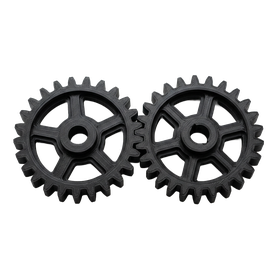
According to our data sheets, Nylon PA6-CF has a tensile strength of a full 170 MPa, clearly the highest of the materials in our range, with an elongation at break of 18 percent. The carbon fibre reinforcement gives the material great stiffness and wear resistance, while the density is kept low at 1.17 g/cm³. The low friction also makes it suitable for moving parts such as plain bearings and gears.
Mechanical and functional parts that need to withstand a lot. Brackets, holders, gears, plain bearings and technical components where strength, stiffness and wear resistance are decisive. It is a natural step up when PETG or ABS is not quite enough.
Technical data
The table summarises the key figures from our data sheets, with PLA as the reference. Exact values may vary slightly between colours and variants.
When should you choose Nylon?
Our Nylon filament is at the same low price per kilo as the rest of the range. If you are unsure where the different materials work best, you can start with PLA vs PETG.
→ Choose Nylon PA6-CF
When the part needs to be really strong, stiff and hard-wearing and withstand high temperatures. Mechanical parts, gears, plain bearings, brackets and technical components. Provided your printer can handle high temperatures and has a hardened nozzle.
→ Choose something else
If a tough everyday part is enough, PETG does the job more easily. If the part needs to withstand heat but not extreme loads, ABS is an alternative, and for outdoor use you choose ASA.
Frequently asked questions about Nylon
Do I need a hardened nozzle for Nylon PA6-CF?
Yes, it is strongly recommended. The carbon fibre in the material is abrasive and quickly wears down an ordinary brass nozzle. A hardened nozzle lasts considerably longer.
Why should Nylon be stored dry?
Nylon absorbs moisture from the air easily, and moisture in the filament can affect print quality. Store it dry, preferably in an airtight container with desiccant, and dry it before printing if necessary.
Is Nylon PA6-CF the strongest material you have?
In tensile strength, yes. It measures 170 MPa according to our data sheets, which is clearly the highest of the materials in our range. The combination of strength, stiffness and wear resistance makes it one of the highest-performing choices.
Can my printer handle Nylon?
It depends on the printer. It needs to handle nozzle temperatures of 230–280 °C and a bed of 70–100 °C, and for the carbon fibre version the nozzle should be hardened. Many modern printers can manage this, but check the specifications first.
Nylon in 1 shade, from 280 SEK
Varje färg provtryckt, vakuumpackad med silikagelpåse och skickad från Tibro inom 48 timmar.