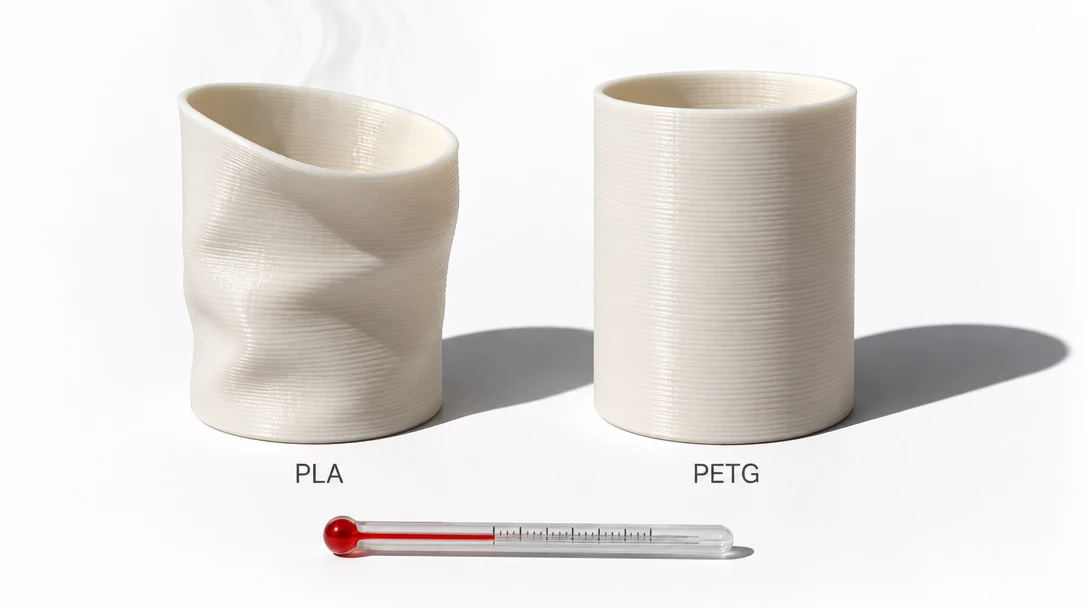
Short answer
Want the easiest possible print and sharp detail? Choose PLA. Should the part be functional and withstand moisture, chemicals and load? Then PETG is the right choice.
PLA or PETG: the short answer
Choosing between PLA and PETG really comes down to what the part will be used for. PLA is the easiest to print and gives the sharpest detail. PETG is stronger and resists moisture and chemicals — the right choice when the part actually has a job to do.
Easy & detailed
Polylactic acid
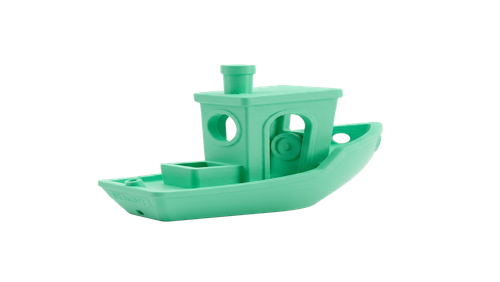
Best for: Figures, prototypes, decor & beginners
- Easiest to print
- Sharpest detail
- Low warping & shrinkage
- Industrially compostable
Strong & tough
Polyethylene terephthalate glycol
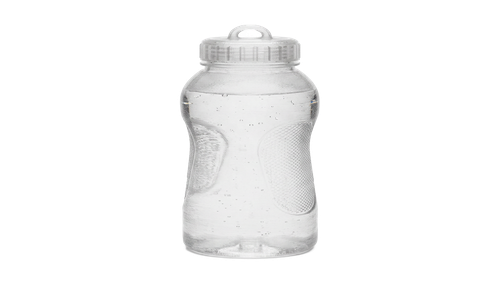
Best for: Functional parts, mounts & technical parts
- Impact-resistant & tough
- Resists moisture & chemicals
- Good layer adhesion
- Easier to print than ABS
Printing and adhesion
PLA is forgiving. It barely warps and shrinks little, so it suits beginners and everyday projects alike. Print at 190–220 °C with the bed at 40–65 °C — and it handles really high speeds, with our High Speed variants going up to 350 mm/s.
PETG takes a bit more feel, but in return it bonds unusually well between layers. It wants more heat: 220–255 °C, bed 50–70 °C, speeds up to 300 mm/s. Once you find the right settings, the parts come out strong and tightly bonded.
The tensile strengths are close: PLA 63 MPa, PETG 53 MPa according to our data sheets. The difference lies in character rather than the numbers. PLA is stiff and dimensionally stable; PETG is a little softer and handles impacts better. If you need PLA that can take more of a knock, there is PLA Pro, a tougher variant of the same material.
PETG resists moisture and chemicals well, a safe choice when the part is exposed to water or cleaning agents. PLA is made from renewable raw materials and biodegrades over time — it suits you best when you want an easy print and a nice result, full stop.
Technical data
The table summarises the key figures from our data sheets. Exact values may vary slightly between colours and variants.
Which should you choose?
Many people who print at home keep both materials on the shelf: PLA for most things, PETG for the parts that need to be functional. Both are available in a wide range of colours in our selection, including transparent, matte and carbon fibre variants, at the same low price per kilo. If you want to read more about PETG as a material, we go through it in What is PETG?, and once you have chosen, we show the right settings in How to print PLA and How to print PETG respectively.
→ Choose PLA
When you want the easiest possible print, sharp detail and low warping. Figurines, models, prototypes, gifts and decoration. The obvious choice for beginners.
→ Choose PETG
When the part should be functional and withstand moisture, chemicals, bending and impacts. Brackets, holders, lids, bottles and technical parts.
Frequently asked questions about PLA and PETG
Is PETG stronger than PLA?
Almost equal in pure tensile strength (PLA 63 MPa, PETG 53 MPa according to our data sheets) — but PETG is tougher and more impact-resistant, while PLA is stiffer and a little more brittle. For parts exposed to impacts, PETG usually wins.
Which is easiest to print for beginners?
PLA, without a doubt. Minimal warping, low shrinkage, lower temperature — the most beginner-friendly material there is.
Can I print both PLA and PETG on the same printer?
Yes, both run on the vast majority of ordinary FDM printers without any modification. The only difference is the temperature — PETG wants it hotter.
Which material handles heat best?
PETG. It prints hotter (220–255 °C compared with PLA's 190–220 °C) and holds up better in a finished part exposed to heat.
Filament in 173+ shades, from 115 SEK
Varje färg provtryckt, vakuumpackad med silikagelpåse och skickad från Tibro inom 48 timmar.