Short answer
New to this? Buy a spool of PLA in a colour you like and start there. It is the only material that almost always just works, and it is also the cheapest.
The best filament for beginners: the short answer
PLA is the best filament for beginners. It is cheap, has minimal smell and is forgiving to print: it hardly warps, sticks easily to the bed and works on practically any 3D printer with standard settings. Start with PLA, learn the basics, and move on to other materials when you want specific properties. You will find all the colours among our PLA filament.
Rule of thumb: New to this? Buy a spool of PLA in a colour you like and start there. It is the only material that almost always just works, and it is also the cheapest.
Why PLA is the best place to start
PLA (polylactic acid) is made from renewable raw materials and has properties that make it ideal for newcomers. It shrinks little, which means minimal warping, and it prints at a relatively low temperature without needing an enclosed printer. So you do not need advanced equipment to succeed.
Forgiving. Low warping and good adhesion even with standard settings.
Cheap. The lowest price per kilo, so it does not matter if your first prints fail.
Minimal smell. Pleasant to print at home.
Wide range of colours. Fun to get started with, and fine detail on models.
Recommended beginner settings
Starting values for PLA according to our data sheets. Most printers handle PLA straight away, so this is mostly a reference to start from.
Common beginner mistakes
If you want a more detailed walkthrough, read our practical guide How to print PLA.
When should you move on from PLA?
→ Stay with PLA
For figurines, models, prototypes, decoration and everything you print for fun. PLA goes a long way and is the most enjoyable to start with.
→ Try the next material
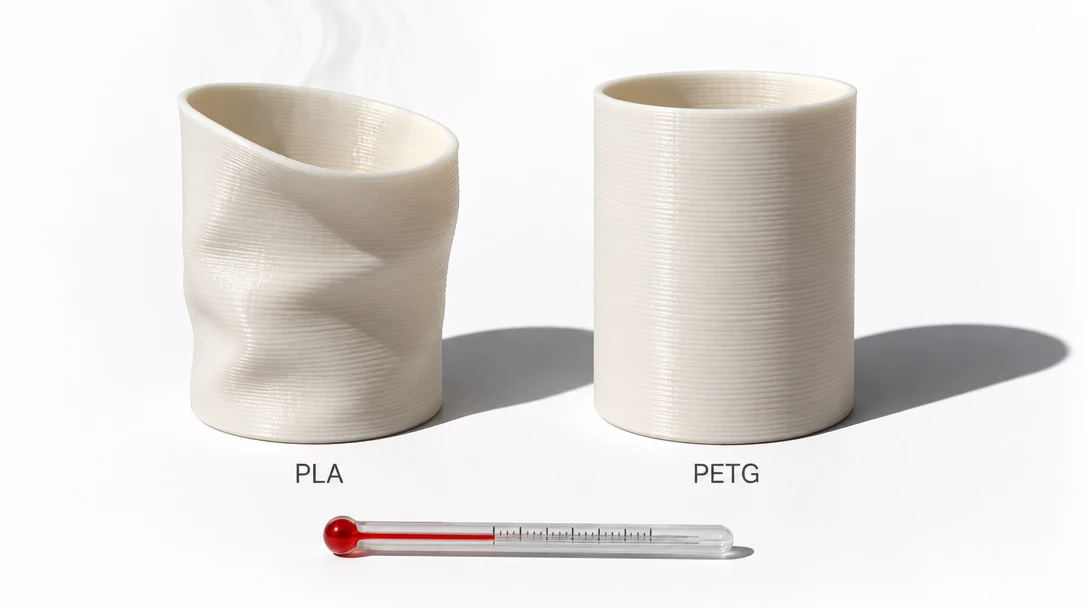
When the part has to withstand moisture, heat or impacts. PETG is a natural step two for functional parts, and it handles more than PLA without being much harder.
Frequently asked questions about filament for beginners
Which filament is easiest to print?
PLA, by a wide margin. It warps minimally, sticks easily and prints at a low temperature without an enclosure, which makes it the most forgiving material for beginners.
Do I need an expensive printer to start?
No. PLA works on practically any ordinary FDM printer with standard settings. You need neither an enclosed printer nor special equipment to get started.
What temperature should a beginner use?
For PLA: around 205 °C on the nozzle and 60 °C on the bed according to our data sheets. Take it slowly with the first layer, it is the single most important thing for a successful print.
What should I try after PLA?
PETG is the most common next step. It withstands moisture, chemicals and impacts better than PLA and is still relatively easy to print. Do read PLA vs PETG for a comparison.
PLA in 88+ shades, from 115 SEK
Varje färg provtryckt, vakuumpackad med silikagelpåse och skickad från Tibro inom 48 timmar.