Short answer
Do you want the easiest possible print, sharp details and a wide range of colours? Choose PLA. If the part needs to withstand heat, moisture or heavy load, PETG, ABS or ASA are better suited.
What PLA is
PLA (polylactic acid) is the most widely used 3D filament, and for good reason. It is made from renewable raw materials, prints with minimal warping and low shrinkage, and is easy to use.
Easy & detailed
Polylactic acid
Best for: Figures, prototypes, decor & beginners
- Easiest to print
- Sharpest detail
- Low warping and shrinkage
- Industrially compostable
Not for heat and heavy load
Everyday material
Less suitable for: Parts in heat or under heavy load
- Stiff but somewhat more brittle
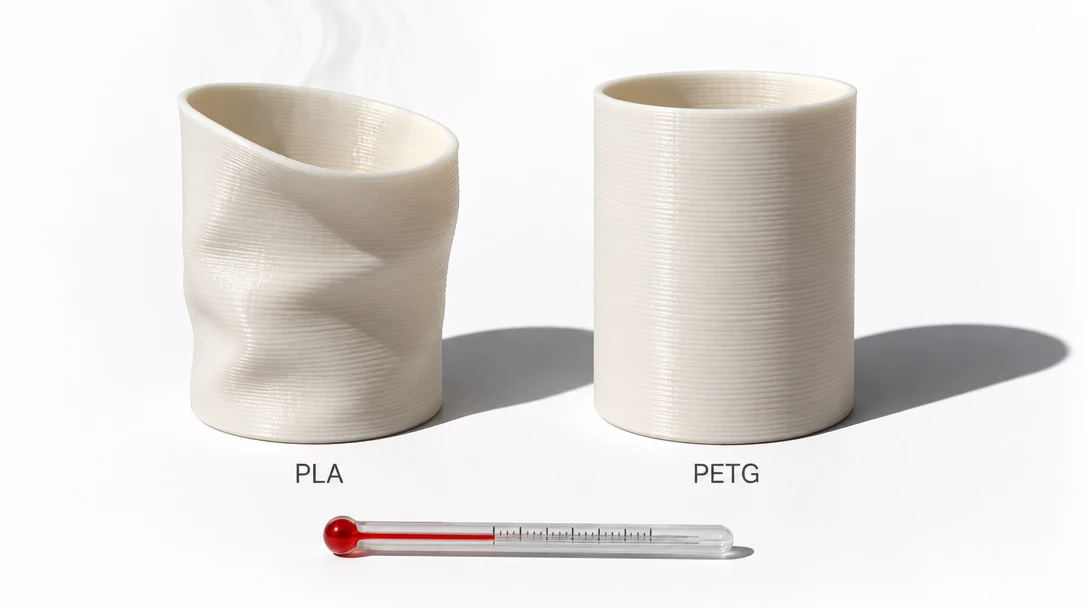
- Softens in heat sooner than technical materials
- Less suitable for outdoor use
- Better choices exist for functional parts
Why PLA is so easy
Easiest to print. A forgiving material that sticks well to the bed even with default settings.
Sharpest detail. Cools quickly and lays down even, fine layers without post-processing.
Low warping and shrinkage. Requires neither an enclosure nor special equipment.
Industrially compostable. Certified to EN 13432, made from renewable raw materials, unlike petroleum-based materials.
Strength and properties
According to our data sheets, PLA has a tensile strength of 63 MPa, which is actually high compared with many other materials. Its character is stiff rather than tough, however, with an elongation at break of 5.2 percent, so PLA withstands less impact than, for example, PETG.
If you want a PLA that can handle more, there is PLA Pro, a tougher version with greater impact resistance and mechanical strength that keeps the easy printing. The material also handles high speeds — our High Speed variants go all the way up to 350 mm/s.
A wide range of variants
One of PLA's strengths is how many finishes it comes in. Besides classic PLA we have, among others, matte, which hides layer lines and gives a soft surface without post-processing, as well as transparent, silk, marble, glitter and carbon fibre. This lets you choose exactly the right look for your project without changing material.
Technical data
The values come from our data sheets and may vary slightly between colours and variants.
When should you choose PLA?
If you are unsure whether PLA is enough for your project, it is worth seeing how it compares with the next most common material in PLA vs PETG
→ Choose PLA
When you want the easiest possible print, sharp details and low warping. Figurines, models, prototypes, gifts and decoration. The obvious choice for beginners and for most of what you print at home.
→ Choose something else
If the part needs to withstand moisture, chemicals or knocks, choose PETG. If it needs to handle heat, ABS is better, for outdoor use ASA, and if it needs to be soft and bendable you choose TPU.
Frequently asked questions about PLA
Is PLA good for beginners?
Yes, it is the most beginner-friendly material. It warps minimally, shrinks little and prints at a lower temperature without an enclosure or special equipment, which makes it easy to get right.
Is PLA strong?
In pure tensile strength PLA is actually strong, at 63 MPa according to our data sheets. It is stiff rather than tough, however, so it withstands less impact than PETG. For parts exposed to knocks there is PLA Pro, a tougher version.
Does PLA withstand heat?
PLA softens in heat sooner than technical materials such as PETG, ABS and ASA. For parts exposed to heat, for example in a car or near electronics, one of those materials is a better choice.
What is the difference between PLA and PLA Pro?
PLA Pro is a tougher version of standard PLA with greater impact resistance and mechanical strength. It keeps PLA's easy printing and compostability but can handle more functional parts.
PLA in 88+ shades, from 115 SEK
Varje färg provtryckt, vakuumpackad med silikagelpåse och skickad från Tibro inom 48 timmar.