Short answer
PETG suits functional parts that need to withstand moisture, chemicals and load, for example brackets, holders, lids and technical parts. It prints at 220–255 °C on most standard 3D printers.
What PETG is
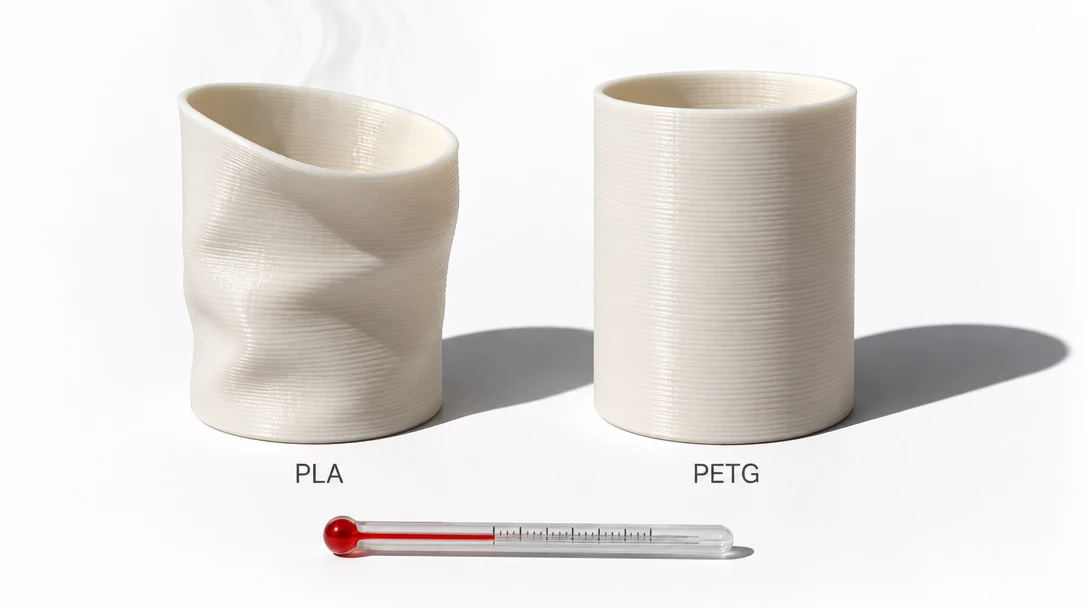
PETG (polyethylene terephthalate glycol) is one of the most popular materials for 3D printing. It combines strength, impact resistance and a degree of flexibility, which makes it ideal for functional parts. PETG bonds well between layers, withstands moisture and chemicals, and is easier to print than ABS while being tougher than PLA.
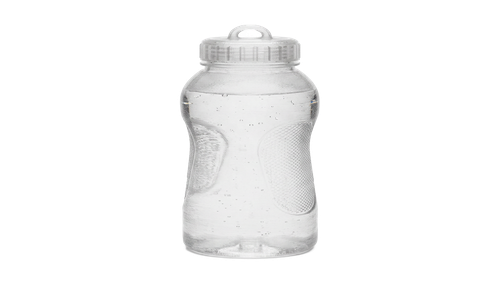
PETG is essentially the same plastic found in many drinks bottles (PET), but with added glycol that makes the material easier to print and less brittle. It is a good next step if you already master PLA and want to print stronger, more durable parts.
Advantages of PETG
PETG takes a little more feel than PLA. It is stickier when molten and can string if the settings are not optimal. Once you have found your settings, however, PETG is very stable and reliable. We go through temperatures, retraction and how to avoid stringing in How to print PETG.
Impact-resistant and tough. Combines strength with flexibility, which makes parts less sensitive to knocks.
Resists moisture and chemicals. A good choice for parts exposed to wet conditions, cleaning agents or outdoor environments.
Good layer adhesion. PETG bonds well between layers and gives strong, cohesive parts.
Easier to print than ABS. Does not require as high a temperature and is less prone to warping or lifting from the bed.
Wide range of colours. Available in classic colours, transparent, matte, carbon fibre and glitter.
Properties and technical data
The table shows the technical specifications for our PETG filament. The values come from our data sheets and may vary slightly between colours and variants.
When should you choose PETG?
If you want even stiffer and more dimensionally stable parts, there is PETG Carbon Fiber, reinforced with carbon fibre for more demanding technical projects. Read our comparison PLA vs PETG for a deeper look at the differences.
→ Choose PETG
Brackets, holders and mounts that need to carry load. Lids, containers and bottles (including transparent parts). Technical parts and prototypes that are meant to be used, not just displayed — and anything exposed to moisture, chemicals or outdoor environments.
→ Choose something else
If you need the easiest possible print with sharp details — figurines, models or decoration — PLA is often a better choice.
Frequently asked questions about PETG
Is PETG stronger than PLA?
In pure tensile strength they are close (PLA 63 MPa, PETG 53 MPa according to our data sheets), but PETG is tougher and more impact-resistant, while PLA is stiffer but more brittle. For functional parts that are exposed to knocks, PETG is usually the better choice.
What temperature do you print PETG at?
PETG is printed at a nozzle temperature of 220–255 °C with a bed temperature of 50–70 °C. The exact temperature depends on your printer and which PETG variant you use.
Is PETG difficult to print?
PETG is moderately difficult. It is easier than ABS but slightly more demanding than PLA. The most common problem is stringing, which can usually be solved with the right temperature and retraction settings.
Does PETG withstand moisture and outdoor use?
Yes. PETG withstands moisture and chemicals better than PLA, which makes it suitable for parts exposed to wet conditions or used outdoors.
Can I print PETG on the same printer as PLA?
Yes. PETG works on the vast majority of standard FDM printers without modification. You just need to raise the temperature compared with PLA.
PETG in 34+ shades, from 115 SEK
Varje färg provtryckt, vakuumpackad med silikagelpåse och skickad från Tibro inom 48 timmar.