Short answer
PCTG is PETG's tougher and clearer relative. If the part needs to withstand impacts or be transparent, choose PCTG. For ordinary functional parts PETG is enough, and it is cheaper.
What is PCTG? Quick answer
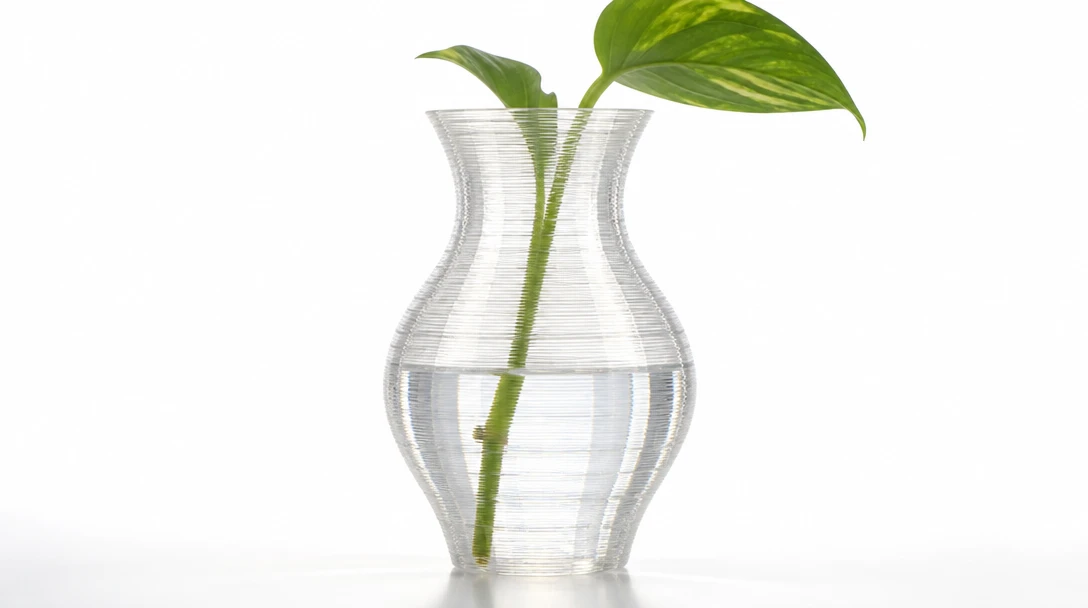
PCTG is a glycol-modified polyester in the same family as PETG (see What is PETG?). It prints almost as easily as PETG, but is tougher and gives clearer transparent prints. That makes PCTG a good choice when a PETG part cracks too easily.
Tougher and clearer than PETG
Glycol-modified polyester
Best for: Transparent covers, protective glazing, containers & parts exposed to impacts
- Withstands impacts better than PETG
- Clearer transparent prints
- Stays tough even in the cold
- Prints almost as easily as PETG
More expensive and hotter than PETG
Higher temperature, dry storage
Less suitable for: Parts where PETG is already enough and price is the deciding factor
- Costs more than PETG
- Nozzle 240–260 °C, bed 70–80 °C
- Keep the filament dry
- Good ventilation is recommended
Rule of thumb: Do your PETG parts crack too easily, or do you want the clearest material possible? Choose PCTG. Otherwise PETG is enough.
Advantages and what to keep in mind
Tougher than PETG. Withstands impacts and stress better, and stays tough even in the cold, unlike PLA.
Clearer prints. Gives clearer transparent parts than PETG, for example covers, protective glazing and containers.
Easy to print. Warps little and adheres well, but requires a higher nozzle temperature and a heated bed.
Costs more than PETG. PETG is cheaper and is enough for most functional parts, so PCTG is the choice for when you need extra toughness or clarity.
PCTG in practice
PCTG is printed at 240–260 °C with a bed temperature of 70–80 °C. Start in the middle of the range and adjust for your printer. Do not print hotter than the upper limit of the range. The approach is much the same as for PETG, see How to print PETG.
Our own Bambu Studio profile for PCTG is based on Bambu's generic PCTG profile, with nozzle temperature and flow ratio calibrated on a test print (258 °C and 0.9975 on a standard nozzle). You will find it among the downloads on the PCTG page.
Store the filament dry, in its packaging with desiccant or in an airtight box, protected from direct sunlight. Damp filament gives a poorer surface finish. If the spool has absorbed moisture, you will find the method in Drying filament. Ensure good ventilation where the printer stands, and do not touch the nozzle or bed during or immediately after printing.
Technical data
The table shows the guideline values we state for PCTG, with PETG for comparison. Start in the middle of the range and adjust for your printer.
We have no measured values of our own for PCTG's tensile strength, so we only show the values we can stand behind. Feel free to compare with PETG's datasheet values.
When should you choose PCTG?
Our PCTG filament is available in 5 shades. If you are unsure about the difference from the simpler materials, you can read PLA vs PETG.
→ Choose PCTG
When the part needs to withstand impacts without cracking, or when you want clear transparent covers, protective glazing and containers. And when a PETG part has been too brittle.
→ Choose something else
For ordinary functional parts PETG is cheaper and is enough. If you want the easiest possible print, choose PLA, and if the part will be used outdoors, ASA is the right material.
Frequently asked questions about PCTG
What is the difference between PCTG and PETG?
PCTG is tougher and handles impacts better than PETG, and gives clearer transparent prints. PETG is cheaper and is enough for most functional parts. Choose PCTG when the part needs to withstand mechanical stress or when you want maximum clarity.
Is PCTG difficult to print?
No, it prints much like PETG. It requires a slightly higher nozzle temperature (240–260 °C) and a heated bed (70–80 °C), but warps little and adheres well.
Do I need to dry PCTG?
Store the filament dry, in its packaging with desiccant or in an airtight box. Damp filament gives a poorer surface finish and stringing. How to dry a damp spool is described in our guide to drying filament.
Is PCTG food safe?
We have no food-safety certificate for our PCTG filament and do not recommend it for anything that comes into contact with food or drink. A 3D print also has small gaps between the layers where dirt and bacteria can remain.
PCTG in 5 shades, from 235 SEK
Every colour test-printed, vacuum-packed with a silica gel sachet and shipped from Tibro within 48 hours.